Market data management · for finance, procurement & market data teams
Market data management,
without the spreadsheets.
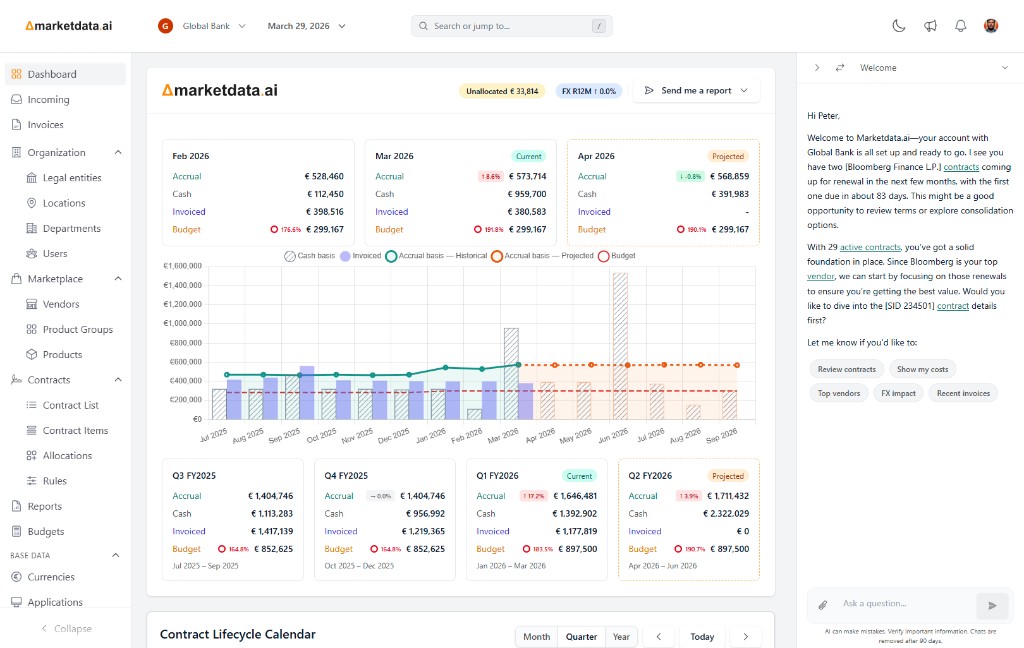
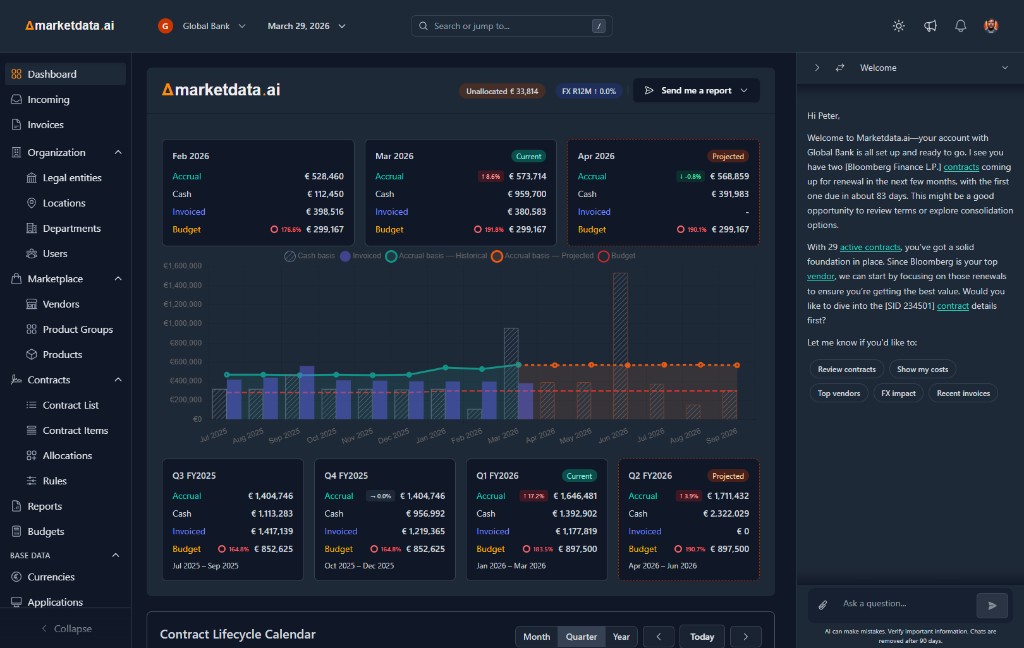
Market data management is how a firm keeps control of what it spends on Bloomberg, Refinitiv, exchange feeds, and every other paid data source — the contracts, entitlements, subscriber counts, and invoices behind them. Most teams still run it on spreadsheets. Marketdata.ai replaces that with one system of record: live cost visibility, allocation to the right cost centre, invoice reconciliation, and an audit-ready history of what changed and why — hosted in Europe.
Contracts · Invoices · Allocations · Audit-ready history
The discipline
What market data management actually covers
Financial market data management is more than a contracts folder. It ties five things together that most firms keep in separate places — and it is the gap between those places where cost leaks and audit findings appear.
Inventory
One record of every vendor, product, and feed you subscribe to — Bloomberg, Refinitiv, FactSet, S&P, ICE, CME, and direct exchange declarations — instead of a folder of contract spreadsheets.
Contracts and entitlements
What you have agreed to buy, on what terms, and what each subscription entitles you to — held next to the cost, not in a separate legal drive.
Cost
Live cost by vendor, department, and user, reconciled against invoices, so finance sees spend on the contract and allocation screens — not only in a month-end export.
Usage and rights
Who is consuming each feed, under which usage rights, so entitlements can be matched to real use before an over-licence or a shortfall becomes a finding.
Compliance and audit
An audit-ready history of contracts, allocations, and corrections, so exchange declarations and vendor reviews are answered from the record rather than reconstructed from email.
The problem
Spend sprawls across vendors, desks, and contracts
A trading floor buys market data from a dozen vendors on overlapping contracts, then spreads the cost across desks, legal entities, and cost centres that rarely match how the subscriptions were bought. Bloomberg is contracted one way, Refinitiv another, exchange declarations another again. The record of it lives in a contracts spreadsheet, a shared mailbox, and last quarter's ERP export.
The result is familiar: nobody can say precisely what a desk costs to run, invoices are reconciled by hand against contracts that may be out of date, and when an exchange or an auditor asks who used what and under which rights, the answer has to be rebuilt from email threads. Market data management solutions exist to close that gap — to make the current cost, the entitlement, and the history answerable from one place.
How Marketdata.ai works
One system of record, not another spreadsheet
Marketdata.ai is purpose-built market data management software: contracts, invoices, allocations, and usage sit in one place, tied to the vendors and cost centres you already use.
Import
Bring contracts and invoices into one record
Upload vendor contracts and forward invoice PDFs into Marketdata.ai. Line items are extracted and matched to the products and entitlements you already track — so the commercial record is current, not rebuilt from email each quarter.
Allocate
Split cost to the desks and entities that incurred it
Tie each subscription to departments, projects, legal entities, or individual users. Shared feeds are split across the desks that consume them, with chargebacks produced from the allocation record rather than a month-end spreadsheet.
Answer
Give finance and auditors a defensible history
When someone asks what changed, who approved it, or what a desk actually costs, the answer comes from the system of record — contracts, invoices, allocations, and corrections — not from reconstructing the past from inboxes.
Cost allocation and chargeback
Allocate every cost to the desk that incurred it
Accurate allocation needs one view of contracts, products, users, departments, and legal entities. Marketdata.ai ties those together, so chargebacks are produced from the record instead of rebuilt each month:
- Allocate cost by department, project, legal entity, or individual user
- Split shared subscriptions across the desks that actually consume them
- Report in multiple currencies for a group with entities in several countries
- Show finance a chargeback they can defend, with the workings behind it
Audit-readiness and European hosting
Keep a defensible history, hosted in Europe
Audits and exchange declarations turn on defensible history: who had access, what it cost, what changed, and when. Marketdata.ai keeps an audit-ready record and lets you view contracts and costs as of any past date, so the answer is the record — not a reconstruction. It runs on EU-primary infrastructure hosted in Germany, with AI processing kept to EU-first sub-processors.



More detail on European infrastructure and security.
Explore the platform
Market data management, part by part
Market data compliance
Track entitlements, usage rights, and vendor contract compliance, and stay ready for exchange declarations and audits.
Spend management
See total market data spend, allocate it to the right desk, and cut the cost you cannot justify.
Data rights & usage
Know who is using what, under which rights, and reconcile usage to entitlements to avoid over-licensing.
Market data management, answered
What is market data management?
Market data management is how a firm governs the paid data it buys from vendors like Bloomberg, Refinitiv, and the exchanges — the contracts, entitlements, subscriber counts, usage rights, and invoices behind every feed. Done well, it gives finance and market data teams one accurate view of what is under contract, who is using it, what it costs, and how that cost is allocated. Marketdata.ai provides that view as a system of record rather than a set of spreadsheets.
How is market data management different from reference data management?
Reference data management is about the accuracy and lineage of the data itself — identifiers, prices, corporate actions. Market data management is about the commercial and compliance side of the same subscriptions: what you are entitled to, what you are paying, who is consuming it, and whether that matches your licence. Marketdata.ai focuses on that commercial and governance layer — cost, contracts, allocation, and audit-ready history.
What does market data management software replace?
For most firms it replaces a patchwork of contract spreadsheets, vendor invoice PDFs, email approvals, and an ERP export at month end. Market data management software brings those into one place, so teams stop reconciling by hand and can answer cost, allocation, and audit questions directly from the record.
Does market data management need to be hosted in Europe?
It depends on your firm's data-residency and GDPR obligations, but for many European institutions EU hosting simplifies the vendor review. Marketdata.ai runs on EU-primary infrastructure hosted in Germany, with AI processing kept to EU-first sub-processors, so data-residency questions have a clear answer.
Can one system cover Bloomberg, Refinitiv, and exchange feeds together?
Yes. Marketdata.ai is built to hold contracts, invoices, and allocations across vendors — Bloomberg, Refinitiv, FactSet, S&P, ICE, CME, and direct exchange declarations — in a single system of record, so cost and entitlement questions are answered across the whole estate rather than one vendor at a time.
See your market data spend in one place
Start free, no credit card. Signup includes a Production account for real setup and a Demo account for safe exploration and internal walkthroughs.